


|
|
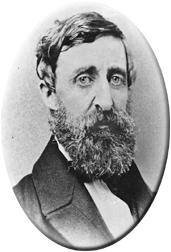
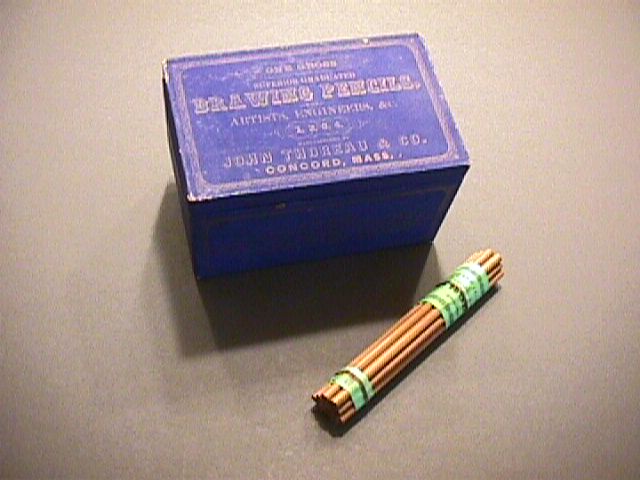
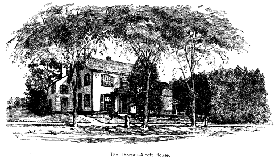
Henry David Thoreau Henry David Thoreau was born on July 12th, 1817 in Concord, Massachusetts in the home of his maternal grandmother, Mrs. Minot. His parents were Cynthia Dunbar and John Thoreau. His father was a businessman and active in the Concord Fire Society. Thoreau's mother spent her time raising Henry and his three siblings, Helen, John and Sophia. Both of Henry's parents loved nature. After graduating from Harvard University in 1837, he taught school and tutored for a short period of time. Thoreau also manufactured pencils in his father's factory. The operation was actually located in the upper story of the Thoreau-Alcott house (see below). He discovered that mixing clay with plumbago (graphite) would make a superior lead. The Thoreau pencils had the reputation of being the hardest and blackest in the United States!
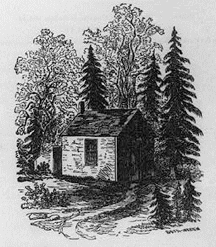
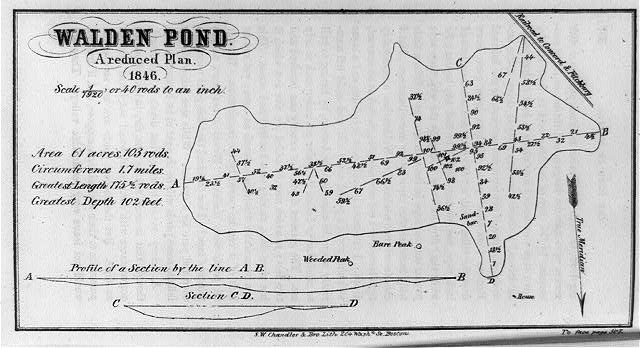
Click on the links below to view movies about the Thoreau pencil making process and finished product. From 1845 to 1847, Thoreau moved to a hut that he constructed on the edge of Walden Pond near Concord, Massachusetts. It was in this location that he wrote A Week on the Concord and Merrimack Rivers, a trip he made with his brother John. His most famous literary work, Walden or life in the Woods was written later. His goal in life was to live simply:
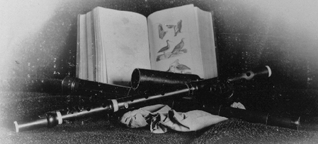
As a frequent guest in the Emerson household, Thoreau entertained the children with magic and fun. He constructed a dollhouse for the Emerson girls that is on display today. He also helped Lidian Emerson when Ralph was traveling. The following is a story about how Thoreau came up with the idea of booties for the chickens so they would not destroy Mrs. Emerson's roses. The little garden which was being planted with fruit-trees and vegetables, with Mrs. Emerson's tulips and roses from Plymouth at the upper end, needed more care and much more skill to plant and cultivate than the owner had; who, moreover, could only spare a few morning hours to the work. So Thoreau took it in charge for his friend. He dealt also with the chickens, defeating their raids on the garden by asking Mrs. Emerson to make some shoes of thin morocco to stop their scratching." - Edward Waldo Emerson from Henry Thoreau as Remembered by a Young Friend. Many consider Thoreau to be the father of the American conservation movement. He loved to walk. His walking stick was notched for measuring things. He also carried a flute, a music book for pressing flowers and a bird identification book by Alexander Wilson. During the latter part of his life he observed and recorded the natural history in Concord.
Henry David Thoreau died May 6th 1862 in the Thoreau-Alcott house, after suffering a prolonged case of tuberculosis, a disease which plagued Henry throughout most of his adult life. He is buried on Authors' Ridge in Sleepy Hollow Cemetery located in Concord.
|
|
|||||||
|
||||||||||







© 1996 - 2011 Linda C. Joseph
All Rights Reserved
All CyberBee Graphics are Trademarked
Graphics by
Darlene Vanasco/Creative Director
Erika Taguchi/Designer & Illustrator
Hosting Provided by Iwaynet